01
Analyse the operation
We sit with the team and time the real work — the copy-paste, the chasing, the checking. The workflow that costs the most hours goes first, not the one that demos best.
BEAT 01
Every business runs on a handful of workflows that quietly cost it hours — a screenshot pasted into a chat, nine websites checked by hand, an order re-typed at a pickup counter.
BEAT 02
We analyse those workflows, build the right stack around them, and host it somewhere durable. Not a pilot — the thing your team uses on Monday.
BEAT 03
Three businesses below. Three operations that used to run on manual effort and now run on their own.
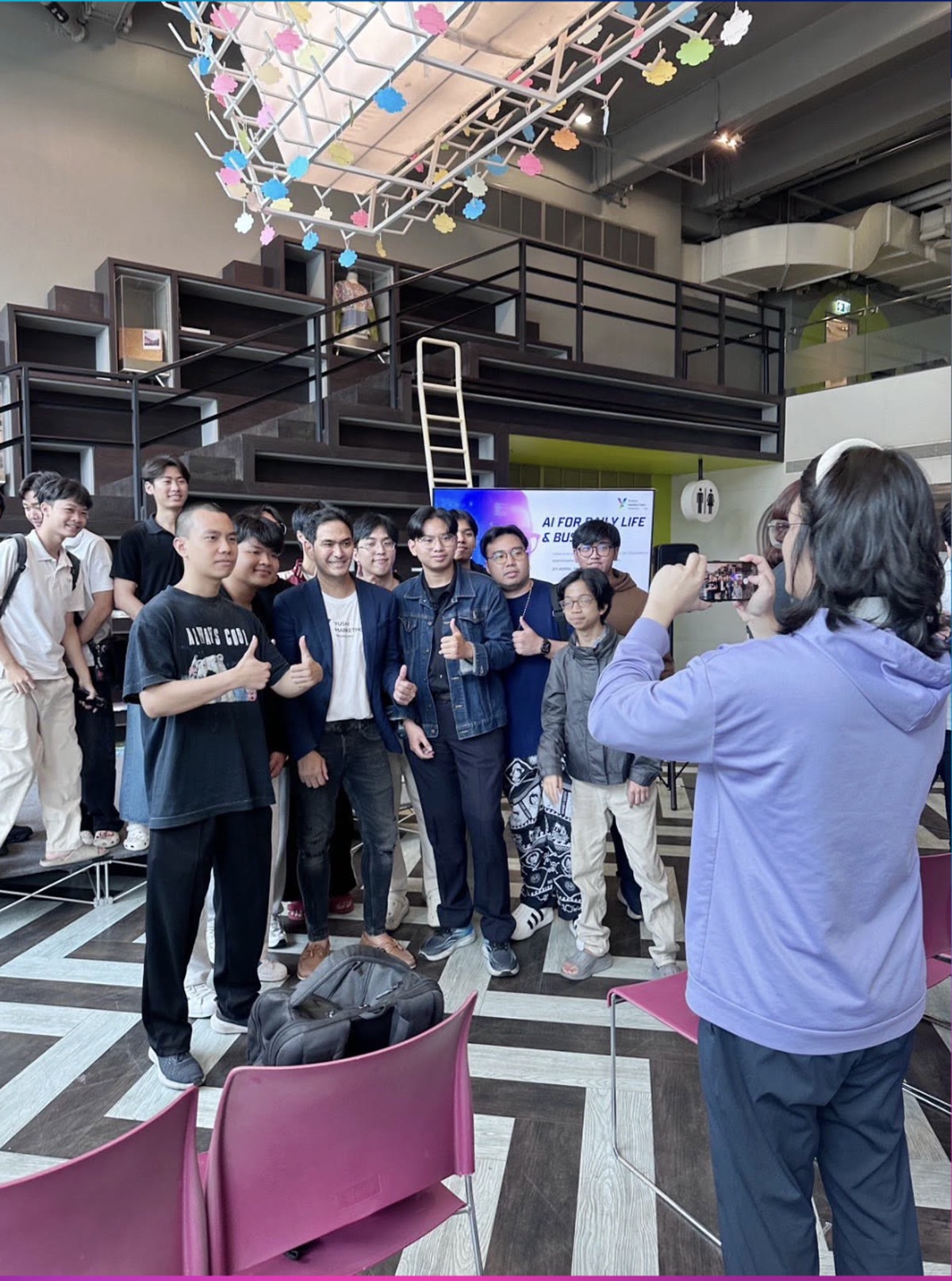
Watcharatorn Chayapongplob
Kris · Founder & CEO, Yushi Marketing Technology
Ex-Google and ex-Amazon, now working at the point where AI stops being a talking point and starts changing how a business actually runs. The three builds below were scoped and led out of this practice.

Completed the Agentic AI programme at MIT Professional Education, 2026.
Extraction, reasoning, classification and drafting are different jobs with different price and latency curves. We benchmark them per workflow and route each one to whatever wins — and re-route when the ranking changes, which it does.
Open-weight models run in your own environment when the data cannot leave it. Where a hosted frontier model is the right call, we say so — and we tell you what it costs per run.
We are not selling you a model. We work out which part of your operation is bleeding hours, choose the tech and AI stack that actually fits it, build it, and keep it running in an environment that does not fall over.
01
We sit with the team and time the real work — the copy-paste, the chasing, the checking. The workflow that costs the most hours goes first, not the one that demos best.
02
Vision models where the input is an image, scrapers and schedulers where it is a website, a proper database where it is a record. The stack follows the problem — never the reverse.
03
An automation that dies quietly on a Tuesday is worse than no automation. We run it in a monitored environment and stay responsible for it staying up.
Each of these started as a workflow someone was doing by hand, every day, and accepting as the cost of doing business.

01 · Distribution & delivery · in-house brand
Our own delivery business — so we felt this one daily before we fixed it.
Before · by hand
Staff screengrab the delivery table from their system.
The image is posted into a LINE group.
The data now exists only as a picture in a chat thread.
Nothing can be totalled, searched, or compared to last week.
After · agent
An agent watches the group and captures each report as it arrives.
It extracts the table from the image into structured fields.
Delivery data is stored properly, with history.
Management reads it as an interactive dashboard, not a photo.

02 · Logistics & freight
Vessel checking across nine separate port websites, done manually by customer service.
Before · by hand
CS staff open nine different port websites, one at a time.
Each vessel status is read off and noted by hand.
The client is updated only when someone gets to it.
Management has no live view of where anything is.
After · agent + TMS
An agent checks all nine ports automatically, on schedule.
Changes are pushed straight to the client as a LINE notification.
A TMS holds the shipment record end to end.
Management sees status live on a real-time dashboard.

03 · Commerce platform · co-owned
A celebrity pre-order platform where a wrong order is a public problem.
Before · by hand
Pre-orders collected and reconciled manually across channels.
Quantities and variants drift between the order and the pick list.
At the event, pickup is matched by hand against a list.
Every mismatch happens in front of a fan, at a counter, in a queue.
After · platform
A purpose-built pre-order platform owns the order from checkout.
That record stays authoritative all the way to fulfilment.
On-event pickup is verified against it, not against a printout.
Built and co-owned by us — we carry the outcome, not just the invoice.
Boring, proven technology chosen because it is still maintainable in three years — not because it was interesting to us this quarter.
PATTERN 01
Two of the three systems above deliver into LINE, because in Thailand that is where the conversation already happens. Nobody had to learn a new tool.
PATTERN 02
The best interface is frequently no interface. If the check runs on schedule and only the exception is surfaced, there is nothing to train anyone on.
PATTERN 03
Dashboards are for the people deciding. Notifications are for the people doing. Confusing the two is how good systems go unused.
We refuse to start at the top. An agent sitting on unreliable data is just a faster way to be wrong.
"A screenshot in a chat group is not a report. It is a report you have not built yet."YMT · AI Transformation practice
The one with the screenshot, the spreadsheet and the person who checks it every morning. That is usually the one worth rebuilding.